
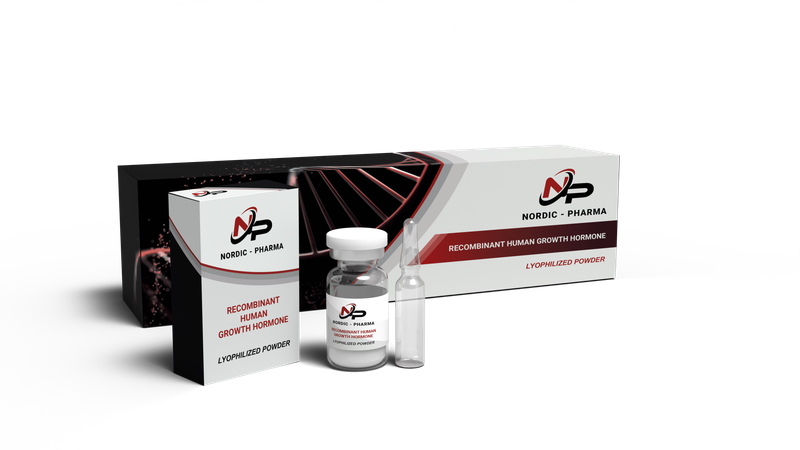
What is GH (growth hormone) in bodybuilding?
GH (Growth Hormone or human growth hormone) is a peptide hormone that the body naturally produces in the pituitary gland.
In bodybuilding and fitness, it is mainly used in its synthetic recombinant form (hGH) for its effects on body recomposition, recovery, and tissue health.
How it really works in the body (in depth)
1) GH → IGF-1 pathway
GH stimulates the production of IGF-1 in the liver and other tissues.
IGF-1 is primarily responsible for:
Muscle hypertrophy and repair
Cellular regeneration
Strengthening of bones, cartilage, and tendons
2) Key metabolic effects
Lipolysis: increases the use of fat as fuel
Glycogen sparing during training
It is not a direct anabolic like steroids; it does not produce rapid strength gains on its own
It can worsen insulin sensitivity if abused or used improperly
3) Circadian rhythm
The body releases GH in pulses, with the largest peak occurring during deep sleep
For this reason, in sports contexts the goal is often to mimic this natural pattern (physiological approach)
What is it used for in bodybuilding? (real objectives)
🔥 Definition: facilitates subcutaneous fat loss
💪 Muscle quality: harder, fuller appearance over time
🧬 Recovery: less soreness and better tolerance to heavy training loads
🦴 Connective tissue: stronger tendons, ligaments, and joints
🧑⚕️ Aesthetics: firmer, more elastic skin (long-term use)
👉 It is a long-term tool, not a “quick mass” solution.
Forms of administration (general overview)
💉 Route
Subcutaneous, not intramuscular
Common areas: abdomen and thigh
Usually supplied as lyophilized powder that is reconstituted before use
⏱️ Common timing (physiological approach)
Before sleep → matches the natural nighttime peak
Fasted → favors fat burning
⚠️ Avoid technical details or practices without medical supervision.
Realistic timelines for results (honest expectations)
2–4 weeks: improved sleep and recovery
1–2 months: firmer skin, slight fat reduction
3–6 months: visible changes in body composition
6–12 months: structural improvements (tendons, overall appearance)
👉 GH is slow, cumulative, and consistent.
Difference between GH, IGF-1, and peptides (common clarification)
GH: primary signal; initiates the cascade
IGF-1: executor of growth and repair
Secretagogue peptides: stimulate endogenous GH production (they are not GH)
Each has different profiles, risks, and effects.
Side effects and risks (detailed)
More likely with high doses, prolonged use, or poor combinations:
💧 Fluid retention
✋ Tingling or numbness (carpal tunnel syndrome)
🦴 Joint pain
🍬 Insulin resistance / worsened glucose control
🫀 Organ enlargement (excessive chronic use)
😴 Sleep disturbances (poor timing)
🚨 Higher risk if there is:
Predisposition to diabetes
Use without medical monitoring
Irresponsible polypharmacy
Common mistakes and myths
❌ “It’s a steroid” → False
❌ “It builds muscle fast” → False
❌ “More is better” → False and dangerous
❌ “It has no side effects” → False
✔️ It is a regulatory hormone, not a magic shortcut.
GH vs anabolic steroids (clear comparison)
GH | Steroids |
|---|---|
Slow and progressive | Fast |
Improves tissue quality and fat loss | Increase strength and muscle mass |
Does not suppress the gonadal axis | Suppress the hormonal axis |
Health / aesthetics focus | Size / strength focus |
👉 That’s why many see GH as a complement, not a replacement.
How to stimulate GH naturally (very important)
🛌 Deep, high-quality sleep (dark, cool, consistent)
🍽️ Night fasting / avoid sugar spikes before bed
🏋️ Intense training (heavy sets, HIIT)
🧘 Reduce chronic stress
🥩 Adequate protein and micronutrients (zinc, magnesium)
These factors make a major difference, even when external GH is used.
GH dosing in bodybuilding
Commonly mentioned reference ranges in bodybuilding
(Not recommendations or prescriptions)
Low dose: 1–2 IU/day
Typical goal: tissue health, skin, mild recovery, fat-loss support
Lowest risk profile
Moderate dose: 2–4 IU/day
Typical goal: body recomposition (less fat + better muscle quality) and recovery
Dose-dependent side effects increase
High dose: 4–6 IU/day
Typical goal: advanced aesthetics / competitive bodybuilding
Clearly higher risk (fluid retention, carpal tunnel, insulin resistance)
>6 IU/day
Not recommended from a safety standpoint
High risk of metabolic and structural adverse effects
🧠 Key idea: with GH, more is not better. Benefits are slow and cumulative, while risks increase with dose.
Typical duration (general approach)
GH is not a short-cycle drug
In sports contexts, changes are discussed in months, not weeks
The longer the use, the more important medical monitoring becomes (glucose, IGF-1, thyroid function)
Effects that are dose-dependent
🔥 Lipolysis (fat burning): increases with moderate doses
🦴 Connective tissue: improves with consistency, not high spikes
💧 Fluid retention & carpal tunnel: clearly dose-dependent
🍬 Insulin sensitivity: worsens as dose increases and dietary control declines
Common dosing-related mistakes
❌ Starting high “to feel something quickly”
❌ Increasing dose without assessing tolerance
❌ Ignoring glucose/insulin
❌ Thinking GH replaces training, diet, and sleep
What to monitor if someone uses GH (safety focus)
Fasting glucose / HbA1c
IGF-1
Blood pressure
Fluid retention and tingling
Sleep quality
Important alternative: stimulate natural GH
Many benefits can be achieved without drugs through:
🛌 Deep, regular sleep
🍽️ Avoiding nighttime sugar spikes
🏋️ Intense training (strength / HIIT)
🧘 Stress control
🥩 Adequate protein and micronutrients (Mg, Zn)
Quick summary
1–2 IU: conservative / tissue health
2–4 IU: body recomposition (medium risk)
4–6 IU: advanced / competition (high risk)
>6 IU: not advisable
Slow results, dose-dependent risks
If you want, I can also:
condense this into a PDF or article format
translate it into German or French
adapt it for a website or educational post
or make a comparison chart with peptides and steroids